
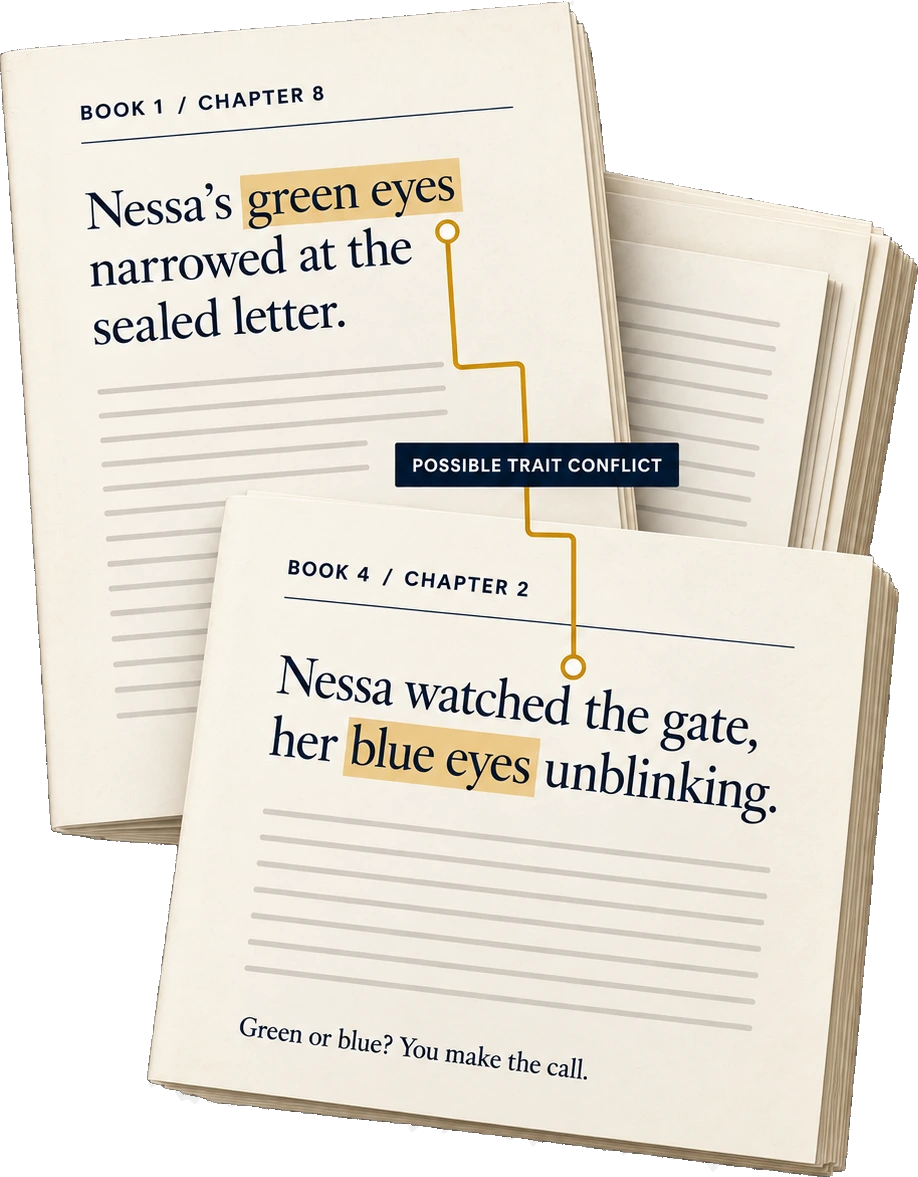
Nessa’s green eyes narrowed at the sealed letter.
AI manuscript analysis for indie series authors
See what StoryHelm catches
Your next book.Meet book one.
StoryHelm is an AI manuscript-intelligence platform for indie series authors. It reads and analyzes an entire fiction series, catches continuity errors before readers do, and never writes or rewrites the author's prose.
Check your inbox.
Your Series Continuity Self-Audit is on its way. Here it is directly, too.
Download the Self-Audit (PDF)Get the guide and StoryHelm emails.
Unsubscribe anytime.
Illustrative example
- Your prose stays yours
- Both versions, side by side
- The final decision is yours
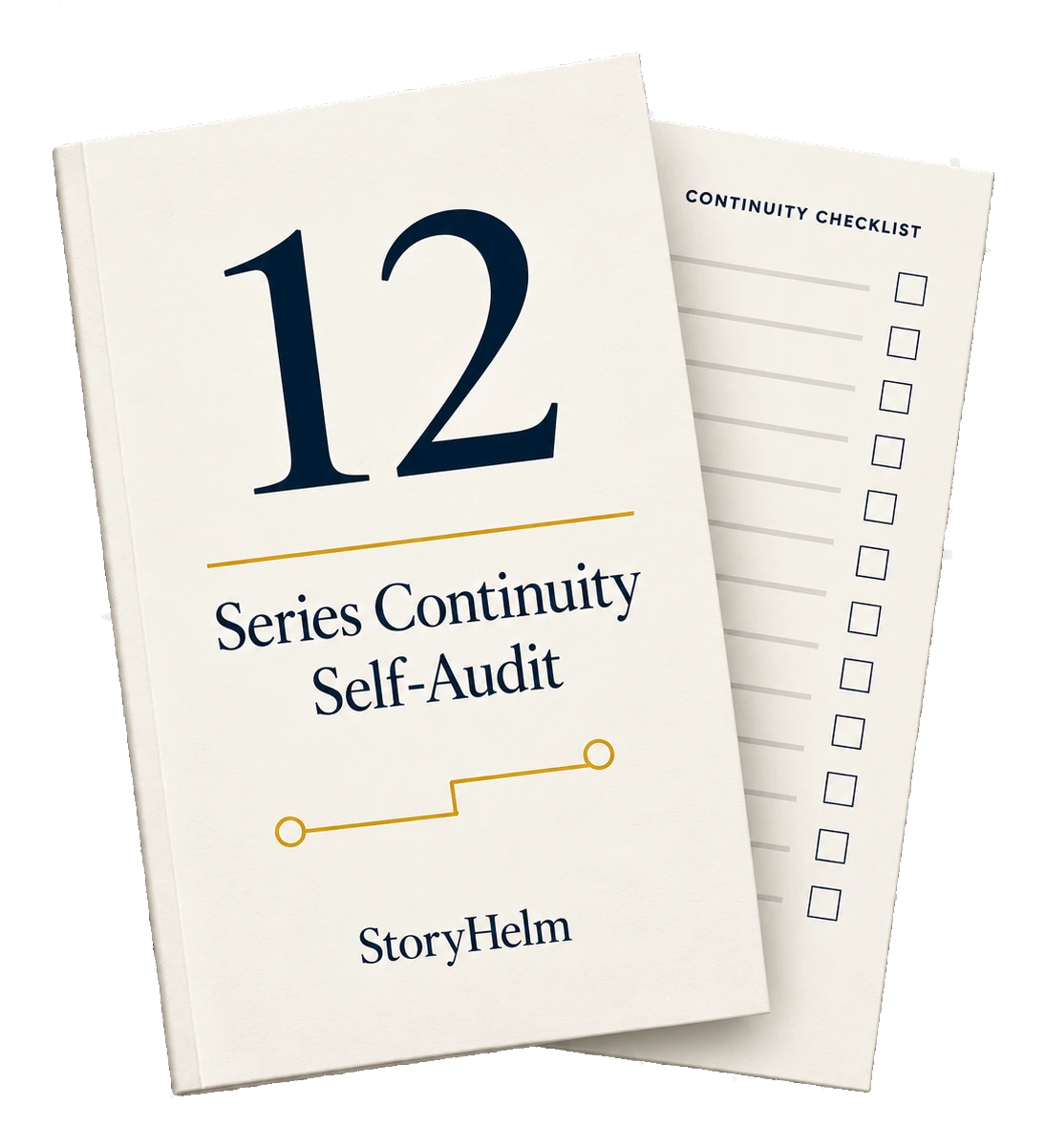
The Series Continuity Self-Audit
A free continuity checklistfor your book series.
Twelve checks for characters, timelines and world rules: a small check for a much bigger story. Read all twelve online.
- 01
Characters who stay themselves
Names, traits, relationships, and the details readers keep.
- 02
A timeline that holds together
Dates, ages, travel, and the order of events.
- 03
Promises you can account for
World rules, planted clues, and unfinished threads.
Get my free Self-Audit
A practical starting point
for your next revision.
One scene. Three books of context.
How a detail drifts between books,and what a cross-book check flags.
A trait readers remember from book one can drift by the time you reach book four.
Illustrative example
He would know those green eyes anywhere.
Nessa watched the gate, her blue eyes unblinking.
Potential trait conflict
Green or blue? You make the call.
A cross-book check names both books and shows what each one records, not the passages.
What StoryHelm checks
The continuity checks StoryHelm runs,inside each book and across your series.
StoryHelm builds a canon of characters, places and events for each book. A Full read flags the contradictions readers notice inside a book, from an eye color that changed to a timeline that doesn't add up. A cross-book check you start compares a character's recorded appearance and voice between books, and the same event's year, month, season or length between two fully read books. You make every call.
-
Character details across books
For characters with the same or a nearly identical name, a cross-book check compares the appearance and distinguishing marks each book records, such as an eye color or a scar, and names both books.
Character consistency across a series -
Voice from book to book
Inside a book, a Full read flags lines where a character stops sounding like themselves. Across books, the check compares how a character speaks once they have 20 or more lines of dialogue in each book.
Character voice drift -
Timelines and event dates
A Full read puts each book's events in story order and flags where its clock breaks. Across two fully read books, the check flags the same event given a different year, month, season or length.
Series timeline tracking -
Foreshadowing setups and payoffs
A Full read finds each book's setups, from the locked drawer to the half-spoken prophecy, and shows which the book pays off and which are still open. Whether a thread stays open is your call.
Setups without a payoff -
World rules inside a book
In a Full read, the Coherence Guardian can flag a scene that breaks a rule the same book set up, such as a touch-only spell suddenly working from across the room. Rules are not compared between books.
When your magic system cheats -
Pacing, scene by scene
Plot DNA scores every scene and plots the book's intensity, so a sagging middle or a rushed climax shows up as a shape on the line.
Pacing analysis, per scene
Full reads come with the Author, Series and Studio plans, and with the free trial at public launch; the Writer plan gets a Quick scan. You start each cross-book check yourself and see its credit cost before it runs. It does not compare names (a renamed character is treated as a new one), world rules, places, relationships or who knew what between books, and there is no master series timeline. Those stay on your list: the 12-check series continuity checklist walks through each one, and the free Self-Audit PDF adds a scoring pass.
See the connections. Keep the control.
How StoryHelm checks your seriesfor continuity errors.
01
Bring your books together
Add the manuscripts you want to check across your series.
02
Follow the evidence
Review each potential conflict with both versions side by side.
03
Make your call
Decide what needs attention and what belongs in your story.
The continuity casebook
Five continuity errors,taken apart.
Each casebook takes one kind of slip apart and says what StoryHelm will and won't catch. Watson's wound is real; the other four are illustrative.
-
Real case
Watson's Wandering Wound
In A Study in Scarlet, Watson's Jezail bullet strikes his shoulder; in The Sign of the Four it is in his leg. In a July 2026 cross-book check of Arthur Conan Doyle's two public-domain novels, StoryHelm flagged the change. It was one of six threads that check opened, and each waits for a person to decide.
-
Illustrative
Helen in Book 2, Hannah in Book 5
A sister renamed between books. StoryHelm won't link the two names on its own; the casebook shows what it can catch once both books use one name.
-
Illustrative
The Scar That Switched Hands
A duel scar on the left hand in Book 1 sits on the right by Book 4: the kind of change a cross-book check compares.
-
Illustrative
The Wedding That Happened Twice
An autumn wedding in Book 1 becomes a spring wedding in a Book 3 flashback, a season change a cross-book check can flag between two fully read books.
-
Illustrative
The Harbor That Moved North
A port city that faced south in Book 2 faces north by Book 5. Places are not compared between books, so this one is yours to catch, and the casebook shows how.
How StoryHelm compares
StoryHelm comparedwith Sudowrite, Novelcrafter and AutoCrit.
AI drafting tools such as Sudowrite and Novelcrafter can write prose for you. In StoryHelm you write every word of your book yourself, in its built-in editor or in files you import, and it reads each book and checks that the series holds together.
AutoCrit, Fictionary and Marlowe also read your book rather than write it. What StoryHelm adds is what it keeps: a canon for every book that you can confirm or correct, gathered in your Series Atlas, and a cross-book check you start when you want your books compared.
StoryHelm at a glance
- Powered by Claude. It reads your books and never writes your prose.
- Two disclosed features write other text: Ship Dock drafts pitch material about your book, and Translation Studio machine-translates a finished one.
- 61 analysis passes across 7 workflows; a Full read runs nineteen of them on each book.
- Your manuscript is never used to train AI, by StoryHelm or Anthropic. Privacy
- Your data exported or deleted on request, by a person.
- Writer plan from $14 a month, billed annually; Full reads start on the Author plan, $35. Pricing

A note from the founder
Your byline.My first rule.
Why StoryHelm's AI reads your manuscript and leaves the prose to you.
StoryHelm began at my kitchen table, in a conversation with my stepdaughter about how novels get written. We kept returning to one problem: a series can grow beyond what any one person can remember.
I built StoryHelm to read across those books and bring the details back into view. It reads. It never writes your prose. The sentences, the decisions and the byline stay yours.
And when you have a question, you can come straight to me. Email me and I'll answer it myself.
scott@storyhelm.comA direct line to the person who built it.
A few things worth knowing
Questions series authorsask about StoryHelm.
What is StoryHelm?
StoryHelm is an AI manuscript-intelligence platform for indie series authors. It reads and analyzes an entire fiction series, catches continuity errors before readers do, and never writes or rewrites the author's prose. It is built from 61 analysis passes across 7 workflows, powered by Claude; a Full read runs nineteen of them on each book.
Can AI check my novel for continuity errors?
Yes, within limits worth knowing. In a Full read (the Author, Series and Studio plans, and the free trial at public launch), StoryHelm checks each book against itself and flags contradictions inside it, from a trait that changes to a clock that breaks, often quoting the line that raised it. A cross-book check you start compares the appearance, distinguishing marks and voice each book records for a character with the same or a nearly identical name, and the same event's year, month, season or length between two fully read books, naming both books and what each one records. It does not compare names, world rules, places, relationships or who knew what between books. You decide what changes. More in What an AI continuity check does, and doesn't.
Will StoryHelm write or rewrite my book?
No. You write every word yourself, in StoryHelm's built-in editor or in files you import, and StoryHelm reads it. Two disclosed features produce text that isn't your manuscript: Ship Dock drafts pitch material about the book (a query letter, synopsis, logline or back-cover blurb) for you to review and edit, and Translation Studio produces machine-generated translated editions of a finished book.
Is my manuscript used to train AI?
No. Neither StoryHelm nor Anthropic trains any model on your manuscript. It is processed to produce your results, and Anthropic keeps API inputs and outputs for a limited window before deleting them, as the privacy page explains. To have your data exported or deleted, email scott@storyhelm.com and a person handles it.
Does StoryHelm build a series bible?
It builds a canon for each book: characters, places, factions, items and events, and you can confirm or correct any entry. Your Series Atlas gathers every book's canon in one place, and you can export a Series Bible as PDF, DOCX or Markdown.
How is StoryHelm different from Sudowrite, Novelcrafter or Plottr?
Plottr helps you outline and keep a series bible by hand, and Sudowrite and Novelcrafter can draft prose with AI. In StoryHelm you write every word of your book yourself, in its built-in editor or in files you import, and it reads each book and checks that your series holds together. Its AI never drafts your prose.
How much does StoryHelm cost?
Four plans, billed annually: Writer $14, Author $35, Series $59 and Studio $199 a month. Billed monthly, Writer is $19, Author $44 and Series $74; Studio is annual only ($2,388 a year). Full reads start on the Author plan. The Series plan is built for series: unlimited books and 1,500 credits a month. A free 14-day trial, with no card needed, comes at public launch. Full detail is on the pricing page.
Do I need to upload my manuscript for the free Self-Audit?
No. The Self-Audit is a free four-page PDF of the 12 continuity checks, with a scoring pass: a guide you use with your own books. Get it from the form on this page or on the Self-Audit page.
The Series Continuity Library
Browse the whole library
Free guidesfor series authors.
Continuity, story bibles, series craft and the publishing business, one topic at a time.
Start here
By genre
Before the next chapter,revisit what matters.
Get the free 12-check Series Continuity Self-Audit.
Check your inbox.
Your Series Continuity Self-Audit is on its way. Here it is directly, too.
Download the Self-Audit (PDF)